After a spy scandal at Nvidia, Congress wants chip limits on China. Law by January?
Senators from both parties want limits on AI chip sales to China in the US defence law. The House plans to stop work for the year on 17 December.
What happened
US lawmakers ask for tighter limits on chip sales to China after the Nvidia spy scandal.
Senators from both parties want new limits on AI chip sales to China. On the Democrat Elizabeth Warren and the Republican Jim Banks asked Congress to pass their AI Overwatch Act inside the National Defense Authorization Act (NDAA). This is the yearly law that sets US military policy. The AI Overwatch Act would let Congress review licences to export the most advanced chips and stop them.
The push follows a scandal at Nvidia, the biggest maker of AI chips. On its chief executive, Jensen Huang, admitted an affair with Alice Huang, a former executive of Megaspeed in Singapore. US officials suspect she worked for China’s intelligence service, and China says the claims are groundless. Nvidia’s board opened its own inquiry, and President Donald Trump said the FBI is looking too.
Three chip measures are on a list of changes the Senate plans to add to the defence bill. Besides the AI Overwatch Act, the Chip Security Act would make companies track where their chips go after export, and the Match Act would push US allies to limit chipmaking tools for China. A House committee approved all three earlier in 2026. Hakeem Jeffries, the Democratic leader in the House, said on that he strongly supports the chip rules.
Nvidia and the White House stand on the other side. A former congressional staff member told Reuters that Nvidia is the biggest opponent of the Chip Security Act and the AI Overwatch Act, and an industry group that includes Nvidia says they could hurt US competitiveness. In Trump let Nvidia sell its H200 chip in China, with 25% of sales going to the US government. On he called Huang “an honourable guy”. The White House has not commented on the measures.
Republicans control Congress only until January. Democrats won both chambers on . Government funding runs out on , and the defence bill is not finished. The House plans to stop work on and the Senate a day later. NPR reports that this year the defence bill is “quagmired in the unforgiving politics of the Iran war”, meaning it is stuck.
Sources: Al Jazeera, The Straits Times, Politico, The Guardian (2), DW, NPR, House Majority Leader
The Pattern
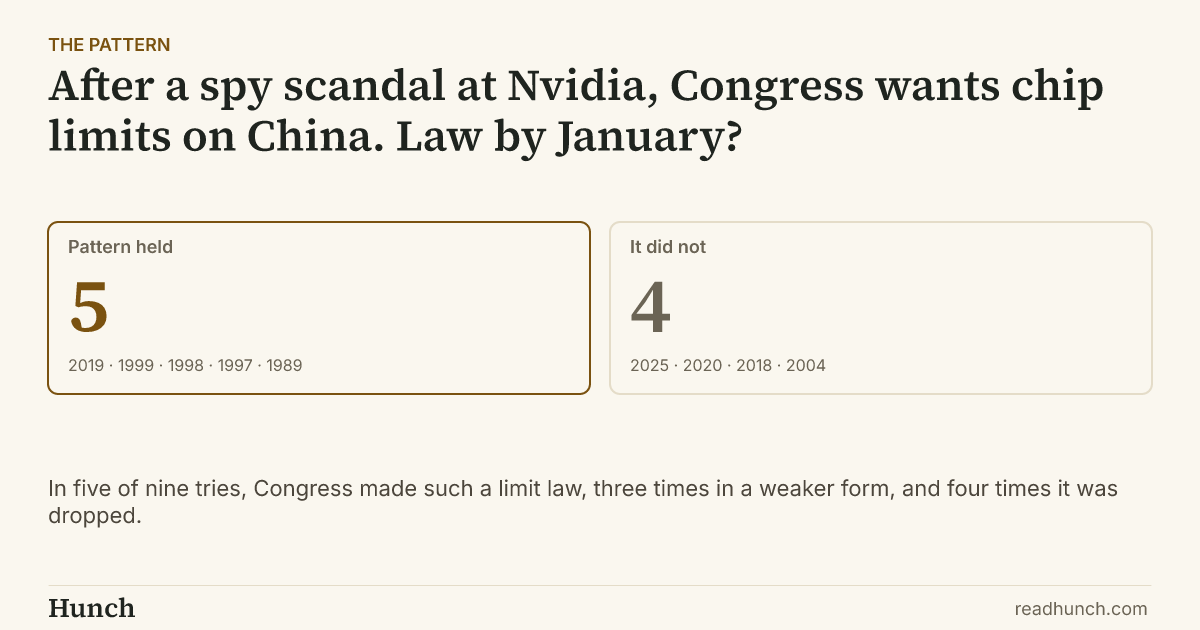
We looked for cases where one chamber of the US Congress passed a rule limiting technology exports to a rival, such as China, and Congress then decided whether to make it law. We found nine such rules from 1989 to 2025, eight of them in the yearly defence law. The subjects ranged from satellites in 1989 to AI chips in 2025. (GovInfo; GovInfo; GovInfo; GovInfo)
Show the other 7 cases
The Read
In five past years the rule was still waiting on , as now. It became law by twice, in 1997 and 2019, both times in a weaker form. In 1989 a veto pushed the law to , and in 2020 and 2025 the rule was dropped. The fastest path from a first vote to law took 113 days. Today’s chip rules are still only on a list of planned changes to the Senate bill. The Senate has not passed its version of the defence bill, and the version the House passed in July does not include them.
There are reasons for doubt. Most past rules were about supercomputers or satellites, and only one was about AI chips: the GAIN AI Act passed the Senate in 2025 and was dropped in December. This time the push has backing from both parties after a scandal. Hakeem Jeffries, whose Democrats take over Congress in January, supports it. When past rules were weakened, a ban or a required approval became a report or a right to object, while the AI Overwatch Act would give Congress a power to block.
Sources: GovInfo (2, 3, 4, 5, 6, 7, 8), The Straits Times, Politico
Disclaimer
Hunch works only from sources that are publicly available, and publishes on the basis of analysis of that material. We do not form an editorial opinion or take sides, we give a simpler and wider view of news that already exists. If information in a source we used was inaccurate, distorted, or later disputed but had already entered our analysis, Hunch accepts no liability for that. Predictions are not advice. Phase 1 markets use Hunch Points, not money.
Published by Hunch under the Editorial Code. Complaints and corrections: /contact/.