The US backs Elon Musk against an EU fine. New EU rulings often came soon after.
The US government asked an EU court on 24 September to let it back Elon Musk's X against a €120m fine. The EU says it will defend the fine.
What happened
The US Justice Department asked the EU’s General Court on to let it join two cases in which X and Elon Musk are trying to cancel a €120m fine from the European Commission.
The fine came on . It was the first fine under the Digital Services Act, the EU law for large online platforms. The Commission said X’s paid blue tick misled users, that X kept poor records of its adverts and that it blocked researchers from public data. The General Court is the lower of the EU’s two courts.
The US says the Commission reached too far. Brett Shumate of the Justice Department said: “The European Commission inappropriately attempted to expand its regulatory authority to reach American companies not present or operating within its jurisdiction.” The US also objects that the fine puts the blame on Musk personally. The Justice Department prepared the filing with the State Department.
On a Commission spokesperson, Thomas Regnier, said it was “ready to defend” its decision in court and had a “solid case”.
The pressure has been building since July. On the Commission fined Google €890m under its digital competition law and gave it 60 days to change its practices or face daily fines. Donald Trump said the EU would “pay a very big price” and threatened a formal trade investigation, known as Section 301. His trade chief, Jamieson Greer, said the EU’s approach risked undoing last year’s trade deal. In the US had already banned Thierry Breton, the former EU commissioner behind the platform law, from entering the country.
A trade date is ahead. Under the deal approved by the European Parliament in June, the Commission can suspend tariff cuts on US goods by if the US keeps its tariffs on steel products. The US has said it will lower those tariffs only if the EU softens its rules for tech companies.
Sources: US Department of Justice, Al Jazeera (2, 3, 4), BBC (2), The Guardian
The Pattern
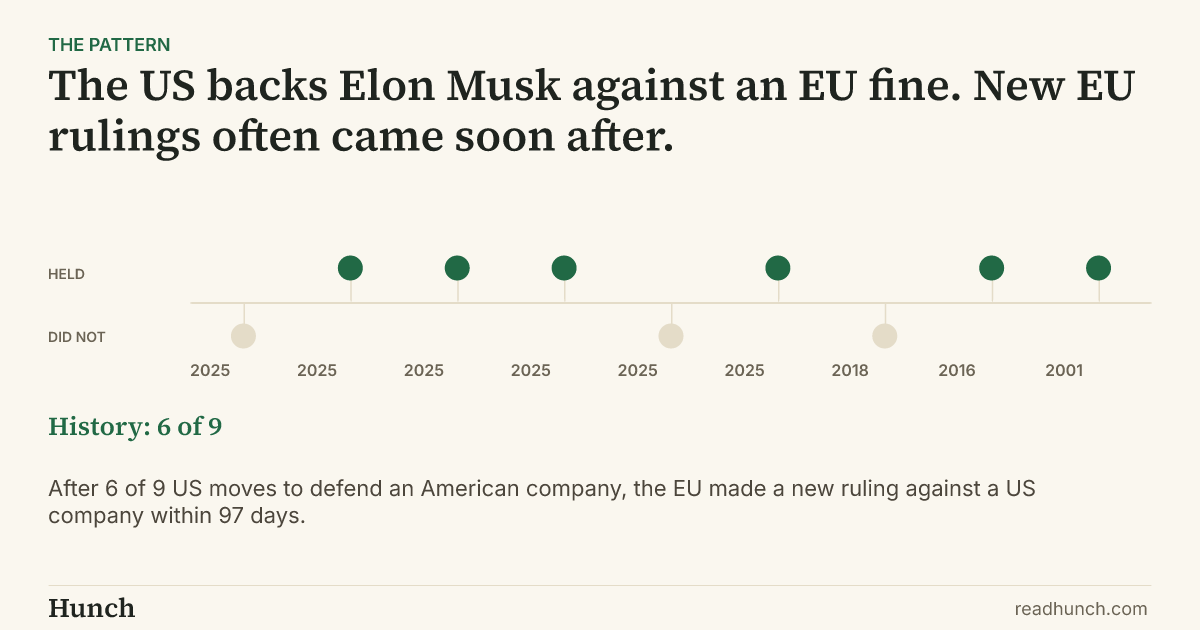
We looked for times since 2001 when the US government publicly took the side of an American company against the European Commission: a statement, a paper, a presidential order, a tariff threat or a visa ban. Then we checked whether the Commission’s next ruling against a US company came within 97 days. It came after six of nine such moves. The Commission decided alone every time.
Show the other 7 cases
not for long!The Commission’s next ruling against a US tech company came in , outside 97 days. (The Guardian, 19 Jul 2018)
The Read
History leans towards yes. After six of nine public moves by the US government to defend an American company, the Commission made its next ruling against a US company within 97 days, once only six days later. In none of the ten cases we checked did the Commission cancel or cut a fine because of US pressure, and in none did the US answer with new tariffs within that time. The pressure changed form instead: statements, an order, visa bans and now a court filing.
The weak points are real. Every case is the same pair, the US and the Commission, and one ruling, the X fine, closes two of them. The three misses came when no ruling was ready, so the record says more about the Commission’s own queue of cases than about how it reacts to pressure. Since Trump’s threat on , 63 days have passed without a new ruling.
Google’s case is the one to watch. Its 60 days to change how its search and app store work ran out in late September, and the Commission can now order daily fines. A case against Meta under the platform law is also open, but X waited about 17 months from similar early findings to its fine.
Disclaimer
Hunch works only from sources that are publicly available, and publishes on the basis of analysis of that material. We do not form an editorial opinion or take sides, we give a simpler and wider view of news that already exists. If information in a source we used was inaccurate, distorted, or later disputed but had already entered our analysis, Hunch accepts no liability for that. Predictions are not advice. Phase 1 markets use Hunch Points, not money.
Published by Hunch under the Editorial Code. Complaints and corrections: /contact/.