Uber opens London robotaxi sign-ups. Most big launch dates since 2016 were missed.
Wayve has raised a $1.2 billion funding round and Uber plans to launch robotaxis in London this year. Waymo says it is coming too. The race is on.
What happened
Uber has opened public sign-ups for London robotaxis, with the first rides — built on Wayve’s self-driving system — expected within months.
Uber and Wayve aim to start robotaxi rides in London in 2026. After London they plan to expand to more than ten markets. Waymo has separately announced plans to bring its service to London. That sets up a direct race on some of the hardest city roads in the world.
Wayve is a self-driving car company based in London that grew out of research at Cambridge. In February it raised $1.2 billion, in a round that valued it at $8.6 billion. Uber added more money, paid as Wayve reaches set goals, which took the total to $1.5 billion.
Microsoft, Nvidia, Mercedes-Benz, Nissan and Stellantis all took part. Wayve says the money pays for commercial robotaxi trials this year, and for private cars that drive themselves with a driver watching from 2027.
The government has moved to meet them. The Department for Transport brought its timetable forward, so that pilots of self-driving taxis and bus-like services could start from spring 2026. The Automated Vehicles Act, the law for self-driving cars, is expected to be fully in force in 2027. The rules are ready. What is left is for a company to carry a paying member of the public with no driver.
The Pattern
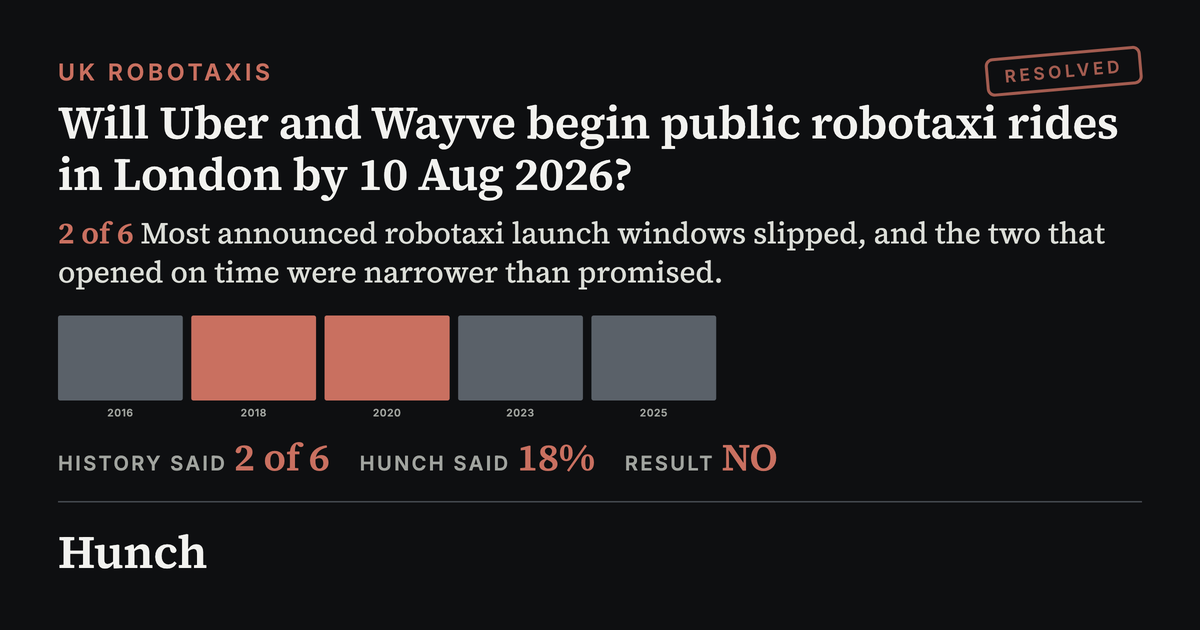
Most big robotaxi launch dates since 2016 were missed. We looked at the launch dates that robotaxi companies announced and checked whether the service opened to the public on time. The few launches that did happen came with safety drivers on board or in small areas.
Show the other 3 cases
The Read
History says be patient. Earlier robotaxi races have run long. Tesla missed its own deadline by five years, Waymo took eleven years from the start of the project to driverless rides for the public, and Cruise collapsed after moving too fast. London has problems Phoenix never had, from roundabouts and rain to a regulator, Transport for London, that has taken away Uber’s licence twice. A 2026 ‘launch’ most likely means a trial with a safety driver late in the year, not a paid driverless ride by August.
There is a case that this time is different. Wayve’s money from Uber is tied to a launch, which puts business pressure behind the date. The Department for Transport has pulled its pilot rules forward to spring 2026 and did not wait for 2027. Waymo’s arrival also punishes whoever moves second. When a government moves fast and two rivals race, launch dates may be met more often than the long record suggests.
The record itself is thin. Of the six launch dates counted here, only four were dates a company had clearly announced. Cruise is the story of a running service that stopped, and Waymo’s 2020 launch had no announced date.
Disclaimer
Hunch works only from sources that are publicly available, and publishes on the basis of analysis of that material. We do not form an editorial opinion or take sides, we give a simpler and wider view of news that already exists. If information in a source we used was inaccurate, distorted, or later disputed but had already entered our analysis, Hunch accepts no liability for that. Predictions are not advice. Phase 1 markets use Hunch Points, not money.
Published by Hunch under the Editorial Code. Complaints and corrections: /contact/.